





As a data and integration-focused consultancy, we view CI/CD as the nervous system that keeps APIs, middleware, and data pipelines in sync across cloud and on-premises estates. Microsoft-hosted agents are great for a quick demo, but their limited compute profiles, lack of VNet ingress, and fixed images can’t support enterprise-grade integration builds – think Logic Apps, Functions, APIM policies, Bicep modules, and premium connectors. Self-hosting solves the control problem, but it shifts the responsibility of patching, scaling, and cost optimisation back to the team. Managed DevOps Pool may be the solution to these problems.
What is a Managed DevOps Pool?
Within Azure DevOps and other CI/CD platforms, a DevOps agent pool acts as a collection of build and deployment agents responsible for executing pipeline tasks. While traditionally self-hosted and manually maintained, a Managed DevOps Pools offers a cloud-hosted alternative.
These pools of build agents (compatible with Azure DevOps, GitHub Actions, GitLab, and more) are characterised by being:
- Pre-configured with popular SDKs and CLIs
- Ephemeral: Creates a brand-new, clean build agent for each job and destroys it after completion
- Auto-scaling: Dynamically adjusts capacity
- Provider-managed: Security updates, patching, and reliability are handled for you
Why Use a Managed Pool?
Managed DevOps Pools let Azure DevOps teams deliver more customer value with less waste by offloading agent patching, scaling, and compliance to Microsoft while still running inside their own VNets (Microsoft spins up short-lived build agents within your Azure subscription using a delegated resource provider. The agents connect directly to your VNet and are automatically managed and cleaned up by Microsoft).
Here’s how Managed DevOps Pools help achieve that:
1. Reduce operational overhead with managed automation
As organisations grow, build pipelines often slow down due to limited self-hosted agent capacity, causing delays, bottlenecks, and reduced delivery speed. Managed DevOps Pools solve this by providing cloud-hosted, scalable build agents that are pre-configured with modern runtimes, tools, and CI/CD environments. This eliminates queue times, enables parallel testing, and supports continuous, uninterrupted deployments.
2. Accelerate build times and shorten delivery cycles
Many teams face slow build pipelines due to limited self-hosted agent capacity. As organisations expand with more services, feature branches, and parallel development streams, these delays compound into delivery bottlenecks that impact productivity and speed.
Managed DevOps Pools eliminate these issues by providing cloud-hosted, on-demand build agents that are pre-provisioned with modern runtimes (e.g., .NET, Node.js, Java, Python), popular tools (Docker, PowerShell, Bash), and up-to-date OS images and CI/CD toolchains. Each job runs in a fresh, isolated environment – ensuring builds start instantly with no queues, tests execute in parallel, and deployments proceed continuously without resource constraints.
3. Ensure consistent builds every time
A major cause of unreliable software builds is inconsistent build environments. With self-hosted agents – especially when shared across teams – issues often arise from conflicting tool versions, outdated SDKs, residual files from previous jobs, and environment drift over time. These inconsistencies lead to unpredictable results and wasted developer effort.
Managed DevOps Pools solve this by using ephemeral, cloud-hosted agents that are freshly provisioned for every pipeline run. Each job starts on a clean slate with no leftover dependencies, pre-installed and version-controlled tools, and identical configurations across all builds, branches, and repositories. This eliminates the familiar “it works on my build agent” problem, ensuring reliable, consistent results from Continuous Integration through to production.
4. Scale without bottlenecks
As teams grow and the number of concurrent builds increases, self-hosted agents can quickly become a limiting factor. Managing agent pools, scaling infrastructure manually, or waiting in build queues slows everyone down. Managed DevOps Pools eliminate these delays through intelligent auto-scaling based on demand. Whether you’re running a single build or 30 across multiple branches, agents spin up instantly – no scripts or manual setup. Your teams get faster feedback, parallel pipelines, and zero wait time – even at peak load.
5. Security that’s always up to date
Managing security patches, isolating environments, and ensuring compliance across self-hosted build agents is time-consuming and error-prone. Residual files, outdated tools, or shared VMs can introduce security risks. Managed DevOps Pools run each job in a clean, isolated VM or container. OS and toolchain updates are handled automatically. There’s no shared state between runs and no need to maintain patch schedules. This reduces attack surfaces and simplifies compliance for regulated industries. Security is baked in, not bolted on.
6. Only pay for what you use
Traditional build infrastructure – on-prem or cloud-hosted – often leads to wasted spend. Idle VMs, over-provisioned agents, and ongoing maintenance all add hidden costs. Managed DevOps Pools are cost-efficient by design. You’re charged per job execution time, not for standing up or maintaining servers. There’s no cost when idle, no infrastructure to manage, and no waste – just fast, scalable builds when you need them.
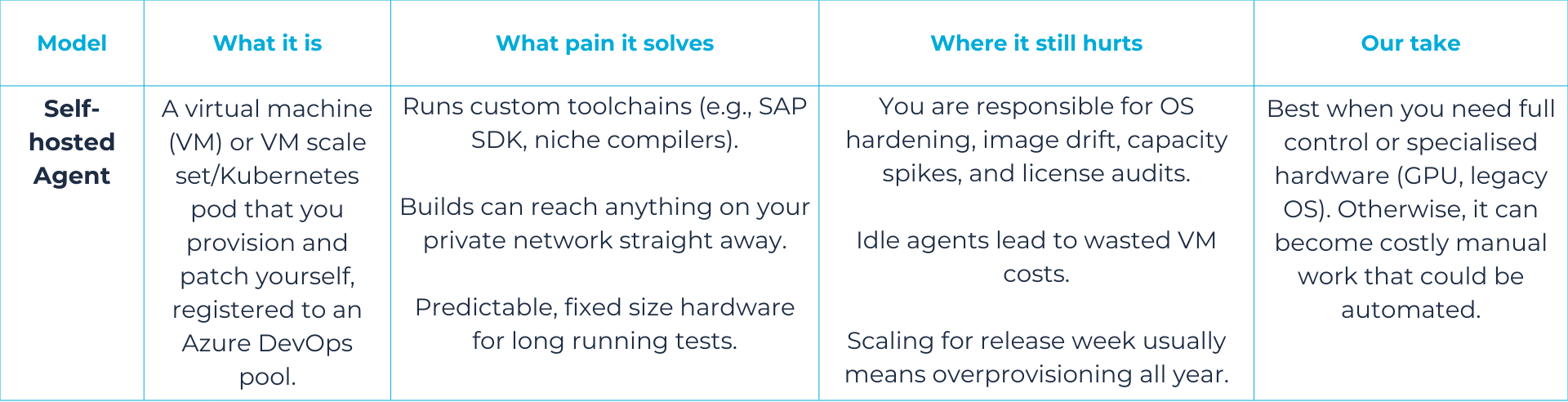
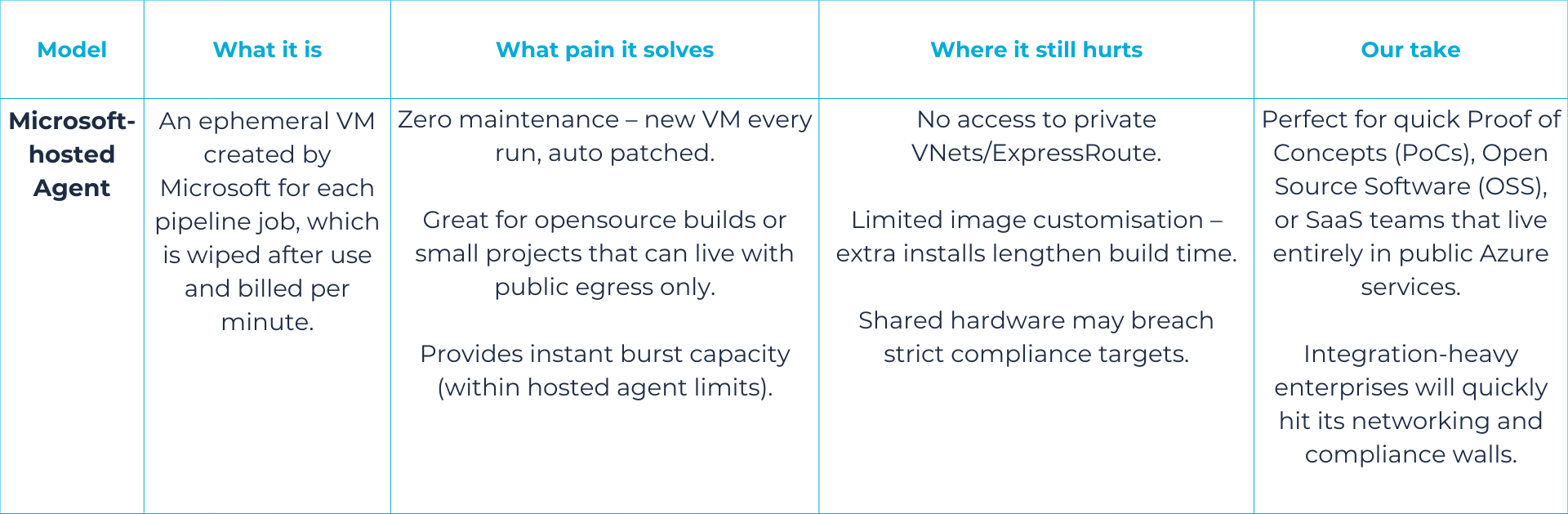
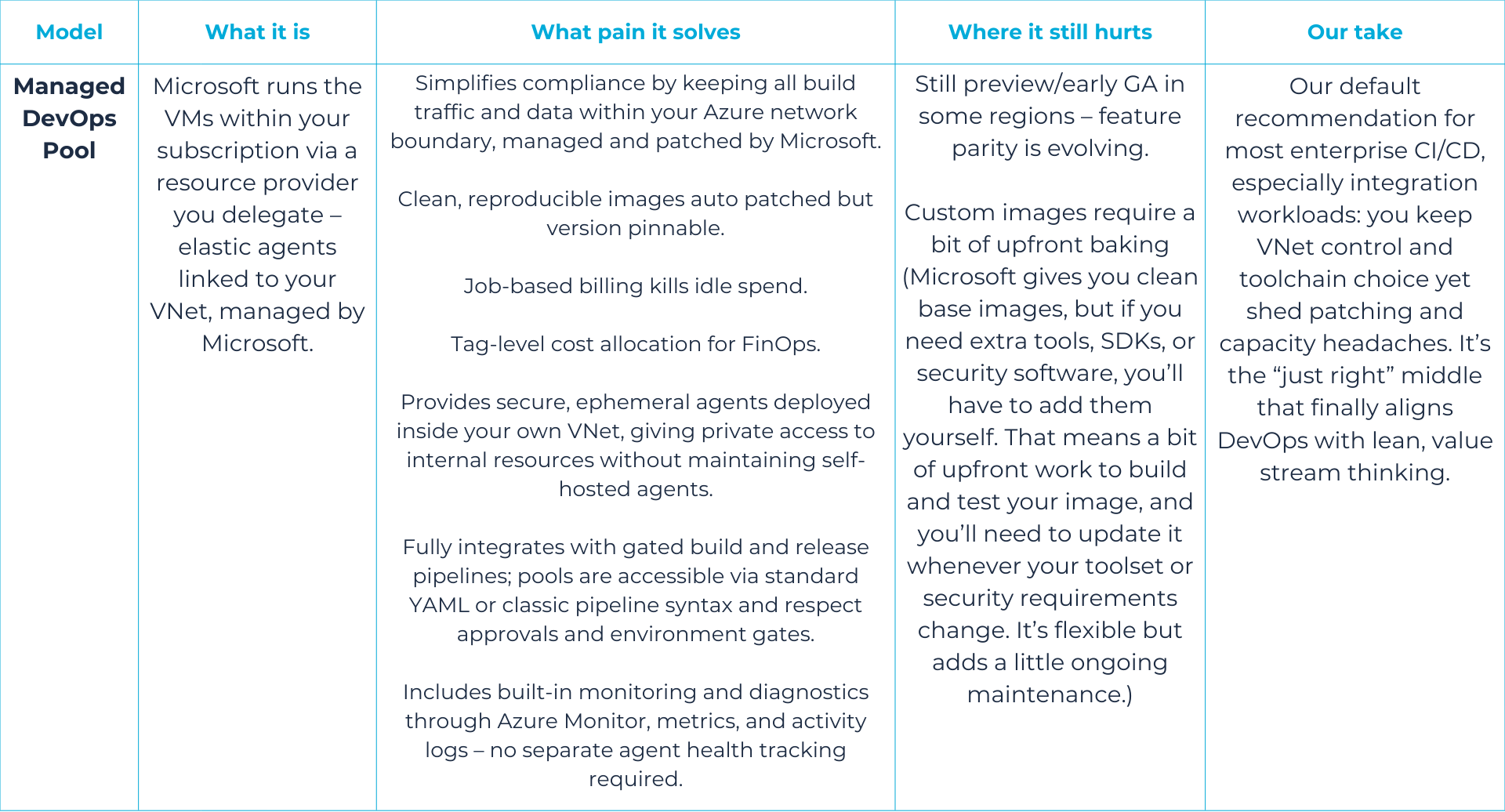
Here’s a clear comparison of Self hosted Agent vs Microsoft-hosted Agent vs Managed Pool in Azure
Self-hosted Agent

Microsoft-hosted Agent

Managed DevOps Pool

Recommendation
If you’re passionate about having complete control over every detail – like special hardware, on-prem AD joins, and legacy binaries – opting for Self-hosted solutions is your best bet. Just remember to automate your image builds and optimise wisely. However, if quick setup and minimal infrastructure worries are your priorities and your code exists in public Azure/GitHub, then Microsoft-hosted options are definitely the way to go.
For the majority of enterprise integration teams looking for private endpoint access with flexible cost control, Managed DevOps Pools offer the ideal balance. They enable you to “buy results, not boxes” – the true spirit of lean DevOps.